

 Terra Pulse Technical Team
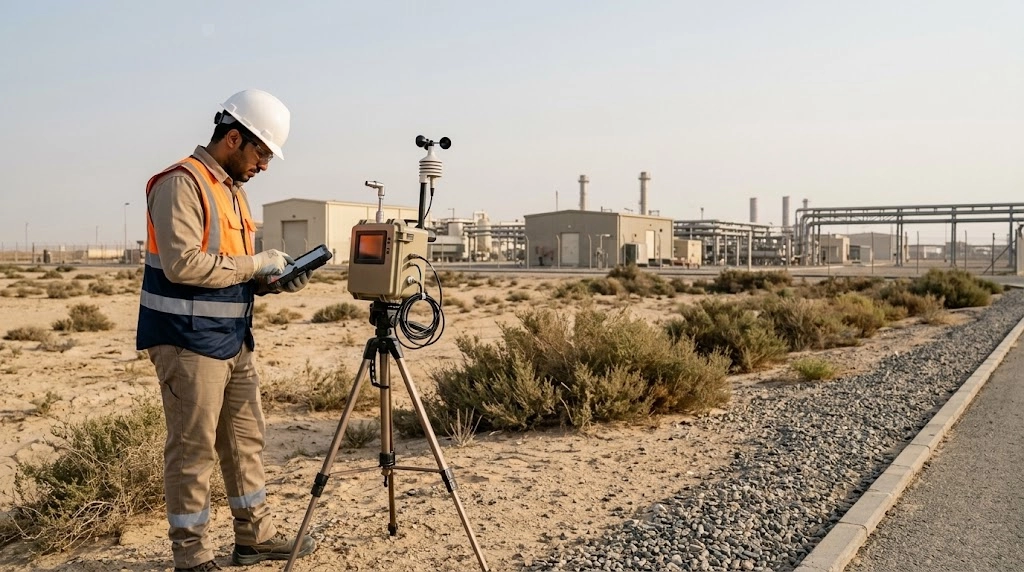
Environmental monitoring helps facilities understand how their activities interact with the surrounding environment. For an industrial facility, construction project or operating site, collecting measurements is only the beginning. The real value comes from knowing why the data were collected, whether they represent actual operating conditions and what action should follow the findings.
A useful environmental monitoring programme connects potential sources of impact with appropriate measurement locations, sampling methods, schedules, quality controls and reporting responsibilities. Depending on the activity and site conditions, it may include ambient air, source emissions, environmental noise, water or soil. The scope should reflect the facility rather than a standard list copied from another project.
This guide explains how to plan environmental monitoring for facilities in Saudi Arabia, from reviewing site activities to interpreting results and following up on corrective actions. Where a facility needs a defined fieldwork and reporting scope, Terra Pulse’s environmental monitoring and measurement services provide a starting point for discussing the activity, available records and required outputs.
1. What Is Environmental Monitoring?
From collecting data to tracking environmental performance
Environmental monitoring is the planned collection, review and interpretation of environmental measurements and observations to assess conditions, track changes and support decisions. A monitoring programme defines what will be assessed, where and when measurements will take place, how reliable data will be obtained and who will respond to the results.
For example, a sound level reading describes conditions at a particular location and time. An environmental noise monitoring programme goes further: it explains why that location matters, which operating activities were taking place, how the measurement was performed and how the result should be assessed.
The programme therefore needs a complete follow-up process. A report that records a concern without identifying a responsible person or the next action leaves an important part of environmental monitoring unfinished.
2. Why Do Facilities Need an Environmental Monitoring Programme?
Detecting changes and checking whether controls are effective
Operating conditions change as facilities introduce equipment, increase production, modify materials or carry out maintenance. Environmental monitoring provides documented information that helps teams assess those changes instead of relying only on visual observations or complaints.
- Track environmental conditions associated with relevant activities and sources.
- Assess the performance of pollution prevention and control measures.
- Support reviews against applicable permit conditions and environmental requirements.
- Investigate unusual results, incidents or concerns raised by neighbouring users.
- Provide evidence for operational improvements and corrective actions.
- Maintain consistent records for future comparisons and reporting.
The benefit depends on how the programme is used. Repeating measurements without reviewing the findings may generate a large archive while providing little help with day-to-day decisions. Useful monitoring links each result to a question, a responsible person and an appropriate response.
3. What Is the Difference Between Environmental Monitoring and Environmental Measurements?
A single measurement versus a structured follow-up programme
Environmental measurements are individual readings, observations or laboratory analyses. Environmental monitoring is the wider process that determines why those measurements are needed and how they will be used. A facility may commission a one-off survey for a defined question, while a longer programme may be needed to understand trends or meet specific commitments.
| Aspect | Environmental measurements | Environmental monitoring programme |
|---|---|---|
| Main purpose | Describe a particular parameter or condition. | Answer defined questions and track relevant conditions over time. |
| Timing | A specific reading, sampling event or survey period. | A planned schedule linked to objectives and applicable requirements. |
| Typical outputs | Readings, analytical results and field observations. | Reviewed results, interpretation, trends, responsibilities and follow-up actions. |
| Operational context | Needs supporting information to be interpreted correctly. | Builds operating conditions and site context into the assessment. |
Neither approach is automatically better. The correct choice depends on the decision being supported. A one-off measurement should not be presented as proof of conditions throughout an entire year when its timing and scope do not support that conclusion.
4. When Should a Facility Start or Update Environmental Monitoring?
Construction, operation, expansion and process changes
Monitoring should be considered during project planning so that relevant baseline information, access arrangements and future responsibilities can be identified. During construction or operation, the programme should reflect the current activity and any applicable monitoring commitments.
A review may also be needed after an expansion, a change in raw materials, installation of a new emission source, modification of a discharge route or an environmental incident. Previous results and recurring complaints may indicate that the existing locations, parameters or schedule no longer answer the right questions.
The monitoring programme should remain connected to the facility’s environmental management plan. When control measures or operating arrangements change, the team should consider whether monitoring also needs to change to assess their performance.
5. How Are Potential Sources of Environmental Impact Identified?
Reviewing processes, emissions, waste and sensitive receptors
Start with the facility’s actual activities. Review process descriptions, site plans, equipment registers, material storage areas, waste handling arrangements and previous environmental records. A site walkover helps confirm whether those documents match current conditions.
The review should connect a potential source with a possible pathway and receptor. For example, material handling may generate dust that can travel towards neighbouring land uses, while a damaged storage area may create a pathway for a release into soil. Identifying a source does not, by itself, establish that a significant impact has occurred.
- List relevant production, construction and maintenance activities.
- Identify potential air emissions, noise sources and discharge points.
- Review chemical, fuel and waste storage areas.
- Map drainage routes and areas with a history of spills or disturbance.
- Identify nearby homes, businesses, water features or other relevant receptors.
Where the source review forms part of a wider assessment, environmental consulting and studies can help connect site information with the questions that the monitoring programme needs to address.
6. What Role Does Baseline Information Play?
Understanding site conditions before interpreting changes
Baseline information provides context for later results. It may describe conditions before construction, before a process change or before a particular activity begins. Relevant records can include previous surveys, operating information, site history, weather observations and data from suitable background locations.
A baseline should be assessed for relevance and quality. An old survey from a different season or operating condition may still be useful, but its limitations need to be understood. A single historical reading should not automatically be treated as representative of normal conditions.
For new projects, baseline investigations may support an environmental impact assessment. For an existing facility without suitable pre-operation data, the team should document that limitation and develop an appropriate assessment approach rather than describe current conditions as an unaffected baseline.
7. How Is the Scope of an Environmental Monitoring Programme Defined?
Linking measurement objectives to the activity, permit and risks
Begin with clear questions. Does the facility need to assess a defined emission source, investigate a potential release, review boundary noise or track the effectiveness of a control measure? Each question should lead to an appropriate parameter, location, method and interpretation approach.
Review applicable permit conditions, approved studies, management commitments and relevant environmental requirements before finalising the scope. Monitoring arrangements used at another facility may be informative, but they should not replace a review of the current site.
- Define the monitoring objectives and intended decisions.
- Identify the relevant activities, sources and environmental media.
- Select the parameters and measurement or analytical methods.
- Set locations, timing, frequency and quality requirements.
- Assign fieldwork, reporting, review and corrective action responsibilities.
- Document how results will be assessed and when the programme will be reviewed.
Where these arrangements need to be incorporated into a broader project framework, environmental management plan preparation can connect monitoring activities with mitigation measures, responsibilities and reporting procedures.
8. How Are Monitoring and Sampling Locations Selected?
Representing sources, site boundaries and surrounding areas
Locations should be selected because they answer the monitoring objective. Depending on the environmental medium, this may involve source locations, facility boundaries, relevant receptors, drainage routes or suitable reference points. There is no single number of locations that suits every facility.
For air quality monitoring, source positions and wind conditions may influence the layout. For water monitoring, the relationship between a discharge, treatment system and receiving environment may be important. Soil investigations require attention to site history, potential release areas and the question being investigated.
Record each location using a clear identifier, coordinates, a description and the reason for selection. Photographs and a marked site plan help future teams return to the same point. If access or site changes require relocation, document the change and consider its effect on comparison with earlier results.
9. How Does Air Quality Monitoring Differ from Emissions Monitoring?
Ambient air conditions and measurements at emission sources
Ambient air quality monitoring assesses pollutants in the surrounding outdoor air, while emissions monitoring assesses releases from a particular source. A boundary air survey and a stack emissions test therefore answer different questions and should not be treated as interchangeable.
Air quality monitoring may consider relevant pollutants such as particulate matter or selected gases, depending on the activity and objectives. Its interpretation needs suitable information about the measurement period, location, weather and surrounding activities.
Emissions monitoring focuses on a defined source or process. Planning may involve operating conditions, suitable sampling access, the required measurement method and relevant reference conditions. A result collected while equipment is idle may not answer a question about its performance during normal production.
The programme should clearly distinguish these activities in the scope, field records and report. Results must be assessed using the appropriate units, averaging periods and applicable references for the type of monitoring performed.
10. How Is Environmental Noise Monitoring Planned?
Selecting locations and documenting operating and measurement conditions
Environmental noise monitoring considers sound in relation to the surrounding environment and relevant receptors. It should be distinguished from occupational noise exposure assessment, which addresses a different question concerning people at work.
Planning starts by identifying significant sound sources, their operating schedules and the locations that need assessment. Equipment may operate continuously, intermittently or only during specific activities, so the timing of measurements affects what the results can demonstrate.
- Define the purpose of the assessment and the relevant acoustic indicators.
- Select representative locations using the applicable method.
- Record operating equipment, nearby activities and unusual sound events.
- Document measurement duration, instrument settings and relevant weather conditions.
- Maintain the required instrument checks and supporting records.
A short reading during a quiet period should not be presented as representative of every operating condition. Reports should explain what was measured and any limitations affecting the assessment.
11. When Should the Programme Include Water Monitoring?
Identifying the water type, potential impacts and appropriate assessment criteria
Water monitoring may be relevant where activities could affect wastewater, surface water, groundwater, stormwater or another identified water stream. The first step is to define the water being assessed and the reason for sampling it.
Parameters should be selected according to the activity, potential contaminants and intended assessment. A routine package that omits a relevant substance may not answer the monitoring question, even if the laboratory report contains many results.
Sampling locations and timing should reflect the system being investigated. Depending on the objective, a sample may need to represent a discharge, treatment stage, particular event or another defined condition. The choice between a grab sample and a composite sample must suit the parameter, method and purpose.
Document the sample identity, collection time, relevant flow or operating conditions and handling requirements. Results from different water types should not be compared against the same reference without establishing that the comparison is appropriate.
12. When Does a Facility Need Soil Monitoring or Investigation?
Storage areas, spills and historical activities
Soil monitoring or investigation may be appropriate where site history, storage practices, an incident or other evidence indicates a potential concern. Relevant areas can include fuel handling points, chemical storage locations, former waste areas or places where releases may have occurred.
The investigation should define its purpose before deciding sample locations, depths and analytical parameters. Surface observations can guide the assessment, but they do not establish the full depth or extent of contamination. Equally, the absence of visible staining does not confirm that soil is unaffected.
Where petroleum contamination is suspected, the assessment should consider the substances involved, potential migration pathways and the data needed for further decisions. Terra Pulse’s guide to petroleum-contaminated soil assessment and remediation explains how site characterisation supports the selection of an appropriate treatment approach.
13. How Are Monitoring Frequency and Timing Determined?
Applicable requirements, operating changes and seasonal conditions
Environmental monitoring frequency should follow applicable requirements and the objectives of the programme. A facility may have different schedules for different sources or environmental media. There is no universal monthly, quarterly or annual schedule suitable for every site.
The planning team should consider process variability, intermittent activities, seasonal influences and the consequences of missing a relevant event. Where a monitoring activity is intended to assess a particular operating condition, the schedule should be coordinated so that the condition is actually captured.
Record the reason for the selected frequency and identify events that require a review, such as a process change or an unusual result. Continuous instruments can provide detailed information, but they still require suitable data review and maintenance. Periodic surveys can be useful when their timing and scope match the question being asked.
14. How Are Methods, Equipment and Laboratories Selected?
Method suitability, reporting limits and calibration requirements
A measurement method should be suitable for the environmental medium, target parameter, expected concentration range and intended use of the data. Selecting equipment because it is available or a laboratory package because it is inexpensive may leave important questions unanswered.
Review the applicable method requirements, instrument performance and the laboratory’s relevant capabilities. Any required licensing, qualification or accreditation should cover the actual work being commissioned rather than an unrelated activity.
- Confirm that the method measures the required parameter in the relevant sample type.
- Check whether the reporting limits are suitable for the intended assessment.
- Review equipment calibration and field verification requirements.
- Confirm sample handling, transport and laboratory arrangements before collection.
- Agree on reporting units, quality information and the treatment of qualified results.
A method that cannot reliably report at a concentration relevant to the assessment may be unsuitable for that decision. This should be resolved during planning rather than discovered after fieldwork is complete.
15. How Is the Quality of Data and Samples Protected?
Field records, chain of custody and quality control
Reliable environmental monitoring requires both a planned quality system and practical checks. Quality assurance establishes how the work will be managed, while quality control provides checks used to evaluate aspects of the measurements and analysis.
Field records should make the work traceable: who collected the data, where and when the activity took place, which equipment or method was used and what conditions could affect interpretation. Samples need clear identifiers that remain consistent across labels, field sheets, custody records and laboratory reports.
Preservation, containers, transport conditions and holding times depend on the sample type, analytes and method. These arrangements should be confirmed with the laboratory in advance. Appropriate blanks, duplicates or other checks should be defined by the programme rather than added without a clear purpose.
When a procedure is not followed or a quality check raises a concern, record the deviation and assess its effect on the intended use of the data. A result should not be presented as fully reliable without considering relevant qualifications.
16. How Are Environmental Monitoring Results Interpreted?
Checking units, conditions and reference values before comparison
Interpretation begins with a review of the data and their context. Confirm that the sample identity, measurement period, units, method and operating conditions are correctly recorded before drawing conclusions.
Any comparison should use the applicable reference for the environmental medium and purpose. A short-term result should not automatically be compared with a long-term average limit, and results expressed under different reference conditions may require appropriate technical treatment before comparison.
A non-detect result does not mean that the substance is absent or that its concentration is zero. It means the substance was not reported above the relevant detection or reporting threshold under the method used. That threshold and any data qualifiers matter when assessing the result.
Where comparable historical data exist, review trends as well as individual results. Explain uncertainty, missing information and limitations so that the report supports a proportionate decision rather than an unsupported statement about the entire facility.
17. What Should Happen When an Unusual Result Appears?
Checking the finding, identifying the cause and following up
An unusual result requires a documented response. First consider whether there is an immediate environmental or safety concern that needs action. Review applicable incident and notification procedures alongside the technical investigation.
- Check the result, sample identity, calculations and relevant quality records.
- Review operating conditions, weather, maintenance and incidents around the monitoring event.
- Investigate plausible causes without assuming that the result is either an error or proof of a particular source.
- Assign corrective or preventive actions with a responsible person and completion date.
- Define how the action will be verified and whether further monitoring is needed.
- Document applicable reporting or notification requirements and the response taken.
Further measurements may help investigate the issue, but the original finding should remain in the record. Repeating a test until a preferred result appears is not a substitute for assessing the initial result and explaining what changed.
18. Example: Developing a Monitoring Programme for an Industrial Facility
A matrix linking parameters, locations, timing, responsibilities and actions
The following hypothetical example illustrates how a programme can be organised for an industrial facility with material handling, mechanical equipment, fuel storage and a defined wastewater stream. It is not a completed Terra Pulse project or a prescribed monitoring schedule. Actual requirements must be established for the relevant facility.
| Monitoring area | Purpose and location | Timing basis | Responsibility | Follow-up |
|---|---|---|---|---|
| Source emissions | Assess a defined emission source using suitable access and methods. | Applicable requirements and relevant operating conditions. | Facility coordinator and appropriately qualified monitoring provider. | Review results alongside process and control equipment records. |
| Ambient air | Assess relevant pollutants at justified locations around the site. | Programme objectives, operating activities and weather considerations. | Environmental coordinator and field team. | Assess findings with background conditions and nearby activities. |
| Environmental noise | Assess sound at relevant boundaries or receptor locations. | Relevant equipment schedules and assessment periods. | Environmental coordinator and competent measurement team. | Investigate significant findings and review feasible control measures. |
| Water | Sample a defined water stream at a representative point. | Applicable requirements, flow conditions and monitoring purpose. | Facility operator, sampling team and laboratory. | Review results against the appropriate reference and operating records. |
| Soil | Investigate an identified concern near a potential release area. | Investigation plan, site history and incident information. | Site management and competent investigation team. | Determine whether further delineation, controls or remediation are needed. |
The working version should also identify the selected parameters, methods, point coordinates, quality checks, reporting deadlines and review arrangements. Once the first results are available, assess whether the programme answers its original questions or needs a documented adjustment.
19. What Common Mistakes Reduce the Value of Environmental Monitoring?
Measurements without a clear purpose, operating context or follow-up
Many weaknesses begin during planning. A technically correct measurement can still be unhelpful if it was taken at an unsuitable location, during an unrepresentative operating condition or using a method that does not answer the assessment question.
- Copying another facility’s monitoring scope without reviewing the current activity.
- Selecting convenient locations without documenting their relevance.
- Measuring while the relevant equipment or process is not operating.
- Changing locations or methods without assessing the effect on comparability.
- Omitting field conditions, instrument checks or sample handling records.
- Comparing results with unsuitable units, averaging periods or reference values.
- Treating non-detects as zero or overlooking laboratory qualifications.
- Issuing reports without assigning actions or reviewing whether they were completed.
Before commissioning the next survey, review the previous report and outstanding actions. This helps ensure that the next monitoring event contributes to a continuing assessment rather than becoming another disconnected set of measurements.
20. Frequently Asked Questions About Environmental Monitoring
What is environmental monitoring?
Environmental monitoring is the planned collection and interpretation of environmental measurements and observations to assess conditions, track relevant changes and support decisions. A programme defines objectives, locations, methods, timing, quality controls and follow-up responsibilities.
What is the difference between environmental monitoring and environmental measurements?
Environmental measurements are individual readings or analytical results. Environmental monitoring is the wider programme that determines why, where and when those measurements are collected, how they are reviewed and what action should follow.
What does an environmental monitoring programme include?
It may include ambient air, source emissions, environmental noise, water, soil or other relevant elements. The scope depends on the activity, location, applicable requirements and identified risks; every facility does not need the same monitoring package.
How are monitoring and sampling locations selected?
Locations are selected according to the monitoring objective, potential sources, pathways and relevant receptors. Each point should have a documented reason for selection, a clear identifier and sufficient location information to support repeat visits.
How often does a facility need environmental measurements?
There is no single frequency for all facilities. Timing depends on applicable requirements, monitoring commitments, source variability, operating conditions and the purpose of the data. Different parameters at the same facility may require different schedules.
What is the difference between air quality monitoring and emissions monitoring?
Air quality monitoring assesses pollutants in the surrounding outdoor air, while emissions monitoring assesses releases from a defined source. Their methods, units, reference conditions and assessment purposes differ, so one does not automatically replace the other.
What should a facility do when monitoring results are unusual?
Assess whether immediate action is needed, review data quality and operating conditions, investigate possible causes and assign appropriate actions. Retain the original result, review applicable notification requirements and verify the effectiveness of the response.
What determines the cost of environmental monitoring?
Cost depends on the parameters, locations, sources, sample numbers, methods, duration, frequency, laboratory analyses, quality requirements, site access and reporting scope. A useful quotation should be based on the facility and monitoring objectives rather than a universal package price.
Environmental Monitoring Programme Checklist
- Clear objectives and intended uses of the data.
- A current description of the facility and relevant activities.
- A review of applicable requirements and monitoring commitments.
- Justified parameters, locations and sampling depths where relevant.
- Appropriate methods, equipment and laboratory arrangements.
- A documented timing and frequency basis.
- Field records and relevant operating or weather information.
- Defined sample identification, custody and handling procedures.
- Quality assurance and quality control arrangements.
- Suitable references and procedures for interpreting results.
- Assigned responsibilities for reporting and corrective actions.
- A process for reviewing and updating the programme.
Conclusion
Effective environmental monitoring connects measurements with decisions. A facility needs to understand the purpose of each monitoring activity, obtain data of suitable quality and assess the findings in their operating and environmental context. Clear responsibilities and documented follow-up make the programme useful beyond the date of the field visit.
Whether the requirement involves air quality monitoring, emissions monitoring, environmental noise, water or soil, the starting point is a scope that matches the activity and the question being investigated. Explore Terra Pulse’s environmental monitoring services or contact our team with your facility location, activity, available documents and monitoring objectives to discuss the appropriate next steps.
Sources and Technical References
For facilities in Saudi Arabia, the programme should be checked against applicable Saudi requirements, permit conditions and project commitments. The EPA resources below provide technical background; their inclusion does not make United States requirements automatically applicable to a Saudi facility.
- National Center for Environmental Compliance: Environmental Media Quality Monitoring.
- US EPA: Basic Information about Air Emissions Monitoring.
- US EPA: Managing Air Quality — Ambient Air Monitoring.
- US EPA: Data Quality and Planning.
- US EPA: Sample Collection.
- US EPA: Quality Assurance Project Plan Guidance.
- US EPA: Holding Time and Preservation.
- US EPA: Quality Assurance and Quality Control.
