

 Terra Pulse Technical Team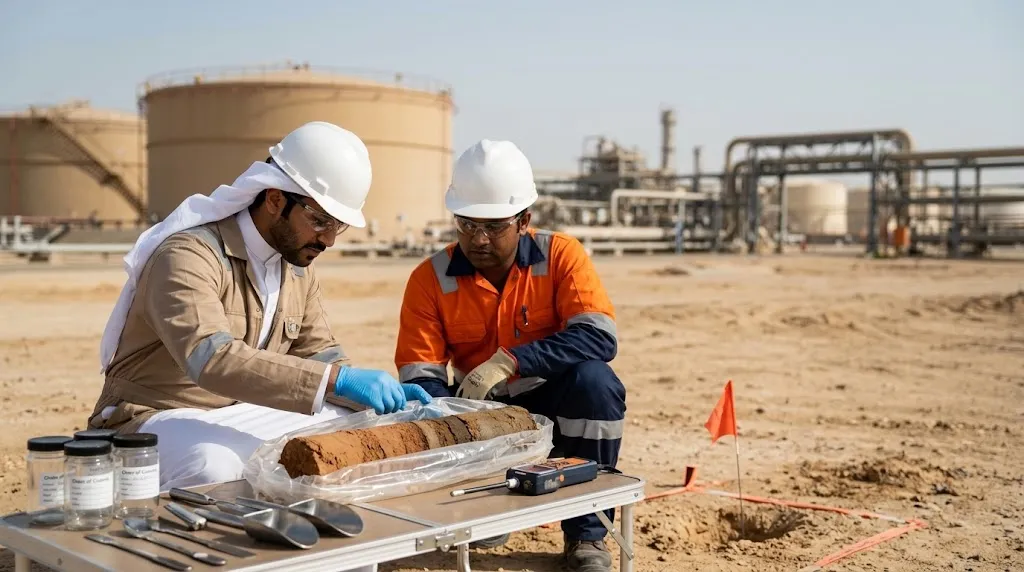
This guide explains how oil-contaminated soil is investigated, sampled and treated, including bioremediation, excavation, soil washing, vapour extraction and thermal treatment. For the wider process, see Terra Pulse’s contaminated site remediation service.
Quick answer: How is petroleum-contaminated soil remediated?
The process generally includes stopping the active release, reviewing site history, identifying contaminants, defining their horizontal and vertical extent, assessing risks, comparing treatment alternatives and verifying the completed work through sampling and analysis.
The selected remedy may include bioremediation, excavation and off-site treatment, soil washing, soil vapour extraction, thermal treatment, containment or a combination of methods. No single technology is suitable for every petroleum-contaminated site.
How does petroleum and oil contamination enter soil?
- Leaks from underground or above-ground fuel tanks.
- Failures in pipelines, valves, joints or transfer systems.
- Spills during loading, unloading and refuelling.
- Hydraulic or lubricating oil released from heavy equipment.
- Drums stored on unprotected ground.
- Uncontrolled disposal of used oils or petroleum sludge.
- Transport incidents, fires or containment failures.
- Historic industrial activities with incomplete environmental records.
Once released, petroleum movement depends on product viscosity, density and volatility, as well as soil grain size, permeability, moisture, geology and groundwater depth. Light fuels behave differently from heavy oils, so the original product and its weathering history should be considered during investigation.
Which petroleum contaminants should be identified?
Oil and petroleum are mixtures rather than individual chemicals. A site may contain gasoline, diesel, aviation fuel, crude oil, lubricating oil, hydraulic oil or a mixture of aged products and industrial waste.
- Total petroleum hydrocarbons: TPH is a useful group parameter but may need suitable hydrocarbon fraction analysis.
- Volatile compounds: these may include benzene, toluene, ethylbenzene and xylenes, commonly grouped as BTEX.
- Polycyclic aromatic hydrocarbons: PAHs may be relevant to heavier fuels, combustion residues and aged contamination.
- Product additives: relevant compounds vary according to fuel type, formulation and release history.
- Metals and other contaminants: used oil or mixed industrial waste may contain substances that will not be identified by hydrocarbon analysis alone.
The analytical list should be based on site history and suspected products. A narrow laboratory scope can miss a contaminant that affects remedy selection, while an unjustified list can add cost without improving the decision.
How are the extent, depth and potential effects determined?
The assessment starts with drawings, operating records, historic imagery, spill records and the locations of tanks, pipelines, maintenance areas and drainage systems. A site walkover then considers staining, odour, disturbed soil, drainage pathways, buildings, wells and nearby receptors.
This information supports a conceptual site model addressing:
- The suspected source and whether it remains active.
- The products and contaminants that may be present.
- The affected media: surface soil, deeper soil, soil gas or groundwater.
- Potential migration pathways.
- People, water resources, ecosystems or structures that may be exposed.
- Data gaps preventing a reliable remediation decision.
Sampling locations and depths are then selected to test the model. The programme may combine targeted samples near suspected sources with locations that define the wider extent. Step-out samples can help establish boundaries. Where groundwater may be affected, hydrogeological assessment and properly designed monitoring wells may be required.
What are the steps for sampling contaminated soil?
- Define the investigation objective: detection, delineation, remediation design or post-treatment verification.
- Develop the conceptual site model: connect sources, pathways and receptors.
- Select sampling locations and depths: use site history, geology and operational information.
- Select laboratory analyses: match TPH fractions, volatile compounds, PAHs and other parameters to suspected products.
- Define quality controls: include suitable duplicates, blanks and documented chain of custody.
- Preserve and transport samples: use the appropriate containers, temperatures and laboratory holding times.
- Validate and interpret results: review laboratory quality information and map results by location and depth.
- Update the site model: refine the contamination boundaries and identify remaining uncertainty.
A defensible report explains why each location and depth was selected, how the sample was collected and preserved, which laboratory methods were used and whether quality-control results support the intended decision.
How is a petroleum soil treatment method selected?
| Selection factor | Why it matters |
|---|---|
| Product and target compounds | Volatility, biodegradability and thermal behaviour differ between compounds. |
| Concentration and age | Weathered or heavy hydrocarbons may be less available for biological treatment. |
| Depth and volume | These affect excavation feasibility, equipment access and treatment capacity. |
| Soil type | Air, water and contaminants move differently through sand, silt and clay. |
| Groundwater conditions | A separate containment, monitoring or groundwater remedy may be needed. |
| Site operations | Active facilities and restricted sites impose access and phasing constraints. |
| Future land use | The intended use affects exposure assumptions and remediation objectives. |
| Secondary outputs | Water, sludge, concentrated soil fractions, filters and vapours require management. |
Treatability tests or pilot trials can reduce uncertainty before full implementation, particularly for biological treatment, soil washing or technologies that are highly sensitive to site conditions.
When is soil bioremediation suitable?
Soil bioremediation uses microorganisms to break down biodegradable organic compounds. It may be applied in situ or after excavation through engineered biopiles, treatment cells or controlled landfarming.
Bioremediation may be suitable when target hydrocarbons can be degraded and when moisture, oxygen, nutrients, temperature and pH can be maintained within workable conditions. The assessment should consider:
- Biodegradability of the target compounds.
- Contaminant concentration and availability to microorganisms.
- Moisture, oxygen, nutrient and temperature conditions.
- Inhibitory compounds or metals that cannot be biodegraded.
- Available area and project duration.
- Control of odour, vapour and contaminated runoff.
- Monitoring capable of distinguishing degradation from dilution or volatilization.
Bioremediation is not suitable for every petroleum site. Highly contaminated hotspots may need excavation or pretreatment, while heavy or weathered fractions may respond slowly. A reduction caused only by moving or volatilizing the contaminant should not be reported as successful biodegradation.
What roles do excavation, soil washing and thermal treatment play?
Excavation and off-site management
Excavation provides direct access and may be suitable for defined hotspots or time-critical projects. Excavated material must be characterized and sent through an appropriate treatment or disposal route. Dust, vapour, water, transport and segregation controls are required during the work.
Soil washing
Soil washing uses water, separation processes and sometimes selected additives to remove contaminants from soil particles or concentrate contamination within a smaller fraction. Performance depends strongly on soil grain size and contaminant properties. Generated water, sludge and concentrated fines require further management.
Thermal treatment
Thermal systems use heat to volatilize, separate or destroy contaminants, depending on the process and temperature. They may be considered for petroleum fractions that cannot be reduced within the available time by biological treatment. Air-emission control, energy use, treated-soil properties and residual material must be evaluated.
Soil vapour extraction
Soil vapour extraction may be considered for volatile compounds in unsaturated permeable soil. The system creates airflow through the contaminated zone, collects extracted vapours and treats them before discharge.
Containment
Containment may reduce exposure or migration when complete removal is impractical and the approach is accepted for the site. Because the contaminant remains, the remedy may require monitoring, maintenance and future land-use controls.
How is contamination prevented from migrating?
- Stop or isolate the active tank, pipe or process release.
- Secure the affected area and control access.
- Protect stormwater drains and prevent contaminated runoff.
- Manage excavation and dewatering water before discharge or reuse.
- Place excavated soil on a suitable lined and controlled area.
- Cover stockpiles where required to control runoff, dust and vapours.
- Define equipment routes and decontaminate equipment before it leaves the work zone.
- Monitor groundwater or soil gas where a credible migration pathway exists.
- Protect workers and relevant environmental or community receptors.
These measures can be integrated with Terra Pulse’s environmental monitoring and measurement services when field measurements or a follow-up programme forms part of the agreed scope.
How is remediation progress measured and verified?
Remediation objectives and verification criteria should be defined before implementation. They may include approved target concentrations, removal of a defined source, control of an exposure pathway or achievement of criteria related to the intended land use.
- Process monitoring: tracks whether the treatment is operating as designed.
- Confirmation sampling: tests representative locations and depths after treatment.
- Post-remediation monitoring: confirms that results remain stable or tracks residual contamination where required.
If verification results do not meet the agreed objective, the plan should define the next action, such as additional treatment, expanded excavation, further investigation or selection of another technology. Completion of physical work does not by itself represent regulatory closure.
Which factors affect remediation duration and cost?
- Contaminated area, volume and depth.
- Contaminant types, concentrations and weathering.
- Soil composition and geological variability.
- Groundwater or soil-gas impacts.
- An active or inaccessible contamination source.
- Investigation, laboratory and monitoring requirements.
- Treatability testing or pilot-stage requirements.
- Transport distance and available treatment facilities.
- Water, sludge and secondary waste quantities.
- Operation of the facility during remediation.
- Health, safety, permitting and reporting requirements.
- Post-treatment monitoring and closure requirements.
A reliable cost cannot be calculated from site area alone. Estimates improve after the conceptual site model, contamination volume, selected technology and secondary material quantities are defined.
A practical petroleum-contaminated soil remediation workflow
- Stop the release and implement immediate containment.
- Review site history, operations, tanks, pipelines and incidents.
- Develop an initial source, pathway and receptor model.
- Complete a documented sampling and analytical programme.
- Assess risk in relation to current and future site use.
- Compare technologies, implementation constraints and secondary outputs.
- Prepare the remediation, monitoring, safety and verification plans.
- Implement the approved work and document quantities and changes.
- Collect confirmation samples against predefined criteria.
- Complete reporting, follow-up monitoring and required closure actions.
Frequently asked questions
Is treating oil-contaminated soil different from treating fuel contamination?
Yes. Heavy and used oils differ from gasoline and diesel in viscosity, volatility, composition and biodegradability. Used oil may also contain metals or other compounds requiring a wider analytical and treatment scope.
Is bioremediation suitable for every petroleum-contaminated site?
No. Its suitability depends on the compounds, concentrations, soil conditions, oxygen, moisture, nutrients, temperature and available time. Highly contaminated or weathered material may need pretreatment or another remedy.
How is contamination depth determined?
Soil borings or excavations are sampled at selected depths and analysed. Additional locations and depths are added until the vertical and horizontal boundaries are sufficiently understood for the decision.
Is one soil sample enough?
Usually not. The number and distribution of samples depend on the site size, release history, geology, contaminant behaviour and investigation objective.
When can treated soil be reused?
Reuse should follow verification against the criteria applicable to the intended use, completion of required reports and approval of the relevant route. Some sites may retain monitoring or land-use restrictions.
Is excavation always the fastest solution?
It may quickly remove a defined hotspot, but it creates transport and treatment requirements and may not address contamination beneath inaccessible structures or within groundwater.
Conclusion
Successful petroleum-contaminated soil remediation depends on diagnosing the site before selecting the technology. The process should stop the source, identify the contaminants, define their extent and movement, compare feasible remedies and verify the results against criteria established before implementation.
Terra Pulse supports project owners and facilities with site-data review, conceptual site models, investigation planning, remediation alternatives, monitoring and verification deliverables within the agreed scope. Explore environmental consulting and studies or contact Terra Pulse to discuss the available site information and the appropriate next step.
