

 Terra Pulse Technical Team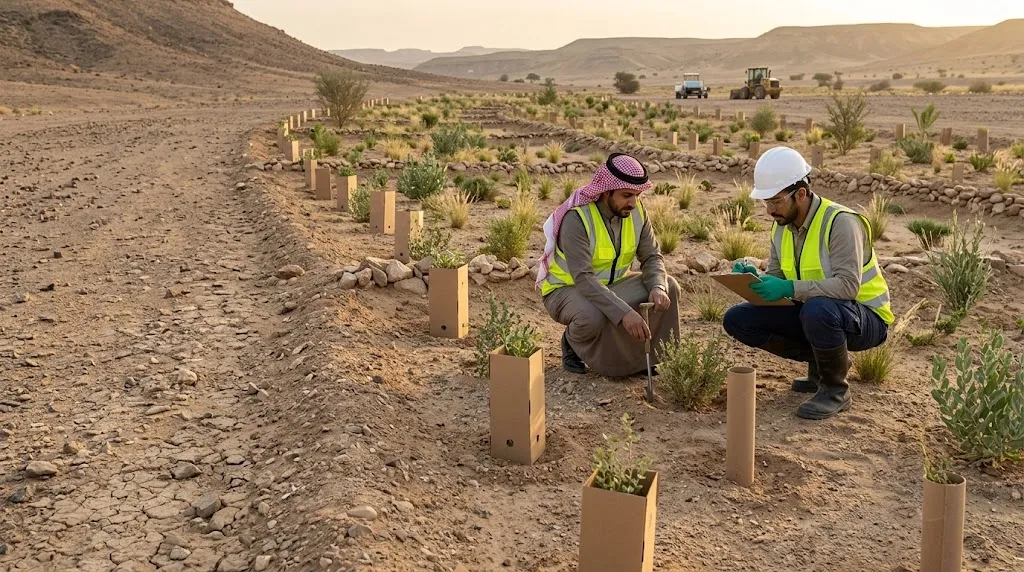
This guide explains how to select native plants, drought-resistant species and soil-stabilising vegetation, then prepare the soil, plant, irrigate and monitor establishment. Before selecting plants, review the causes of land degradation so the rehabilitation plan addresses the factor responsible for vegetation loss.
Quick answer: How are plants selected for degraded land rehabilitation?
Plant selection follows an assessment of climate, soil, salinity, topography, water movement, reference vegetation and ongoing pressures. Priority is generally given to native species from the same environmental setting that can perform the required function, such as stabilising soil, protecting the surface or supporting biodiversity.
The plan should also define seed or seedling sources, planting season, soil preparation, establishment irrigation and protection from grazing, vehicles and pests. Success is measured through survival, vegetation cover, density, natural regeneration and surface stability rather than the number planted alone.
What role do plants play in rehabilitating degraded land?
- Surface protection: leaves and stems reduce direct exposure to wind and raindrop impact.
- Soil stabilisation: roots help bind surface layers, depending on their form and density.
- Runoff control: vegetation increases surface roughness and may slow shallow water movement.
- Soil improvement: plant residues can gradually add organic matter and improve root-zone conditions.
- Biodiversity support: native vegetation provides resources and habitat for associated species.
- Natural regeneration: established plants can improve microsite conditions for later recruitment.
- Dust and sand control: suitable cover and properly designed vegetation belts can reduce wind exposure.
Plants cannot independently stabilise an unsafe landform, remediate contaminated soil or correct an uncontrolled drainage route. Earthworks, drainage, water harvesting, erosion controls or contaminated-site remediation may be required before revegetation.
How should the site be assessed before plant selection?
Climate and microclimate
- Rainfall amounts, seasonality and annual variation.
- Temperature and possible heat or cold extremes.
- Prevailing wind direction and exposure.
- Evaporation, shade and solar exposure.
- Differences between wadis, depressions, slopes and exposed plains.
Soil conditions
- Sand, silt and clay proportions.
- Depth of soil available for root development.
- Compaction, bulk density and surface crusting.
- Salinity, pH, organic matter and relevant nutrients.
- Water infiltration and moisture retention.
- Contamination, waste or shallow rock restricting root growth.
Water and topography
- Runoff routes and water collection areas.
- Slopes and locations affected by erosion or sediment deposition.
- Groundwater depth where relevant.
- Source and quality of establishment-irrigation water.
- Opportunities for suitable rainwater-harvesting measures.
Reference vegetation
Nearby natural areas with comparable soil, landform and climate provide useful references. Record the species, density, distribution and relationship with soil and water features. Geographic proximity alone does not make an ecologically different site a suitable reference.
Continuing pressures
Assess grazing, trampling, vehicles, construction, wood collection, invasive species, fire and pests. Planting can fail even with suitable species if these pressures continue.
Why are native plants preferred for rehabilitation?
Native plants for rehabilitation are species associated with the natural environment of the location. A plant is not automatically suitable because it occurs elsewhere in Saudi Arabia or is available from a nursery. Suitable species differ between coasts, salt flats, wadis, dunes, mountains and interior rangelands.
Native plants may offer:
- Adaptation to the local climate, soils and seasonal cycle.
- Ecological relationships with local organisms.
- A closer pathway toward recovery of the reference plant community.
- Lower risk of introducing unsuitable or invasive plants.
- Potentially lower long-term inputs after successful establishment.
- Protection of regional ecological character and plant genetic resources.
Native status alone does not guarantee suitability. Confirm the species’ natural habitat, soil preference, drought and salinity tolerance, root form, mature size, reproduction and availability from a traceable source.
When should drought-resistant plants be used?
Drought-resistant plants are relevant where rainfall is limited or irregular and evaporation is high, provided they also match the soil and restoration function. Drought tolerance does not mean that a new seedling can establish without water under every condition.
Distinguish between:
- Drought tolerance after establishment.
- Moisture conditions required for seed germination.
- Water needed by young seedlings while roots develop.
- Salinity tolerance, which is separate from drought tolerance.
Establishment can improve when planting is aligned with the appropriate season, rainfall is harvested where suitable, evaporation and competition are managed, and irrigation is delivered to the root zone.
How do soil-stabilising plants reduce erosion?
The stabilising ability of vegetation depends on plant form, canopy density and root architecture. Perennial grasses and fibrous roots can protect shallow soil, while shrubs and trees may provide deeper roots and greater surface roughness.
| Site condition | Required plant function | Possible supporting measures |
|---|---|---|
| Wind-exposed surface | Low cover that reduces continuous bare ground | Temporary surface protection and control of traffic |
| Shallow runoff | Slow water and increase surface roughness | Suitable stone lines, barriers or designed drainage routes |
| Eroded slope | Root reinforcement and surface cover | Slope shaping, drainage and engineering stabilisation |
| Moving dunes | Species adapted to burial, sand movement and drought | Initial wind barriers or surface stabilisation |
| Wadi or channel bank | Plants adapted to changing moisture and water movement | Temporary bank protection and flow management |
Where a slope is geotechnically unstable, planting should not replace the required engineering design.
How do salinity and soil properties affect plant selection?
Salinity may cause weak germination, leaf damage or uneven growth, but visual symptoms do not confirm the cause. Soil testing should be combined with assessment of salt distribution in the root zone, irrigation-water quality, drainage and groundwater where relevant.
- Sandy soils: drain quickly and may need careful establishment irrigation and wind protection.
- Clay soils: retain water but may have poor aeration, hard-setting surfaces or slow drainage.
- Compacted soils: restrict roots and infiltration and may require controlled loosening.
- Saline soils: require suitable tolerant plants and investigation of the salt source and drainage.
- Shallow or stripped soils: may require restoration of a suitable growth medium or reuse of stored topsoil.
Fertiliser, compost and soil amendments should be based on actual need. Uncontrolled additions may raise salinity, introduce weeds or favour plants that do not match the target community.
Illustrative plant groups for rehabilitation
The following examples are not a planting specification. Final selection must follow local natural distribution, site surveys, soil results, plant-material availability and authority requirements.
| Environment or function | Examples for consideration where locally native | What to verify |
|---|---|---|
| Dry rangelands and plains | Panicum turgidum, Rhanterium epapposum, Haloxylon species and other local rangeland plants | Grazing pressure, seed source and soil suitability |
| Wadis and depressions | Vachellia species, Ziziphus spina-christi and associated native vegetation | Flood routes, soil depth and water availability |
| Dunes and sandy areas | Local plants adapted to burial, moving sand and drought | Sand movement and the need for initial stabilisation |
| Saline or coastal environments | Native halophytes suited to the actual salinity and habitat | Soil and water salinity, drainage and natural distribution |
| Degraded slopes | A mixture of local grasses and shrubs with suitable cover and roots | Slope stability, runoff routes and growth-medium depth |
Is one plant species enough to restore vegetation?
One species will rarely restore a diverse plant community or perform every required function. A rapidly establishing species may provide initial cover but may not supply deeper roots, seasonal diversity or habitat resources.
A planting mix may include:
- Pioneer species supporting early establishment.
- Perennial grasses protecting the soil surface.
- Shrubs providing structure and diverse habitats.
- Native trees where they naturally belong.
- Seasonal species that emerge after rainfall.
Diversity does not mean adding the largest possible number of species. The selected mixture should represent the reference environment and be able to coexist under the site conditions.
Soil preparation, planting and establishment irrigation
Address the cause of degradation
Control grazing, traffic, runoff, contamination, waste and any continuing pressure before planting. Replanting while the original driver remains active commonly leads to repeated failure.
Prepare the ground
Work may include controlled loosening of compacted layers, landform preparation, replacement of stored topsoil, small water-harvesting features and repair of erosion channels. The method and depth should reflect soil and topographic conditions.
Select the establishment method
- Direct seeding: can suit large areas where viable seed and suitable germination conditions are available.
- Seedlings: provide visible establishment but require more handling, irrigation and protection.
- Combined planting: spreads risk and allows different plant functions to be introduced.
- Assisted natural regeneration: protects and improves the site so existing vegetation can recover.
Choose the planting season
Timing should reflect rainfall, temperature and the plant life cycle. One calendar date is not suitable for every Saudi region. The selected period should allow root development before the most severe heat or drought.
Manage establishment irrigation
Establishment irrigation supports early root development. Quantity and frequency depend on the species, soil, weather, seedling size and water-harvesting arrangement. Where the objective is self-sustaining native cover, irrigation can be progressively reduced according to plant response.
Projects that require an irrigation and maintenance system can connect the rehabilitation design with Terra Pulse’s landscaping and irrigation services.
How are plant survival and vegetation cover monitored?
| Indicator | What it shows | Possible verification method |
|---|---|---|
| Plant survival | Living plants compared with the number installed | Representative counts or a full count in small areas |
| Vegetation cover | Proportion of the ground protected by plants | Quadrats, transects and fixed-point photographs |
| Plant density | Number of individuals per unit area | Sampling plots distributed by site zone |
| Natural regeneration | New plants establishing without direct replanting | Recording seedlings, species and seasonal emergence |
| Erosion and surface stability | Whether site function is improving | Rill, sediment and post-rainfall inspections |
| Plant health | Stress, pests, salinity symptoms or water problems | Documented inspections and repeat photography |
Each indicator needs a baseline, target, measurement method, timing and responsible party. Measurements can form part of an environmental monitoring programme, with corrective actions linked to the results.
Why do degraded-site planting projects fail?
- Plant species do not match the soil, climate or habitat.
- Grazing, vehicle movement or erosion continues after planting.
- Compacted or shallow soil prevents root development.
- Salinity and poor drainage remain unresolved.
- Establishment irrigation is excessive, insufficient or poorly distributed.
- Planting occurs during an unsuitable season.
- Seeds or seedlings have low viability or poor health.
- Monitoring does not identify failures early enough for correction.
- A single species is expected to perform all restoration functions.
- Planting numbers are reported without measuring survival or cover.
Steps for preparing a vegetation restoration plan
- Define the rehabilitation objective and intended future land use.
- Assess soil, water, topography, vegetation and continuing pressures.
- Select an ecologically comparable reference site.
- Divide the project area into meaningful restoration zones.
- Select the plant mix and verify seed or seedling sources.
- Design soil preparation, drainage, water harvesting, protection and irrigation.
- Use a trial area when species or methods remain uncertain.
- Record planting quantities, locations, methods and dates.
- Implement maintenance, protection and replacement procedures.
- Monitor survival, cover, regeneration and erosion and correct weak results.
For extraction sites, these steps should be coordinated with the wider quarry rehabilitation plan, including landform safety, drainage, soil management and closure criteria.
Frequently asked questions
What are the best plants for rehabilitation in dry areas?
There is no universal list. The most suitable option is generally a mixture of native plants occurring in an ecologically similar environment, selected after reviewing soil, salinity, topography, rainfall and rehabilitation objectives.
Is every drought-resistant plant suitable for soil stabilisation?
No. Drought resistance relates to water shortage, while stabilisation depends on root form, density, plant cover and position on the land surface or slope.
How long does vegetation restoration take?
Duration depends on climate, soil, degradation severity, plant species, establishment method and site protection. Early growth may appear in a suitable season, but stability and natural regeneration generally require monitoring across multiple seasons.
How do I select suitable native plants?
Survey the project site and comparable reference areas, then compare the identified species with soil, water and topographic results. Confirm natural distribution, planting-material source and relevant authority requirements.
Do native plants require irrigation?
Native seeds and seedlings may need establishment water while their roots develop, particularly where rainfall is irregular. Irrigation should be based on the species, soil and season and can be reduced according to the rehabilitation objective and plant response.
Can a site be restored using trees alone?
Not always. Grasses, shrubs and seasonal plants may provide more effective surface protection and a plant-community structure that better reflects the natural environment.
How is rehabilitation success demonstrated?
Success is demonstrated when defined acceptance criteria have been achieved, including suitable survival, cover, natural regeneration and surface stability, and the results remain acceptable during the required monitoring period.
Conclusion
Selecting plants for degraded land rehabilitation begins with diagnosing the site and defining the function that needs to be restored. Native plants provide a suitable foundation where they match the soil, climate and natural habitat, but success also requires control of degradation drivers, soil preparation, water management, protection and monitoring.
Terra Pulse supports degraded-site assessment, soil and drainage review, revegetation planning, irrigation design and rehabilitation monitoring within the agreed project scope. Explore environmental consulting and studies or contact Terra Pulse to discuss the site condition and intended rehabilitation outcome.
