

 Terra Pulse Technical Team
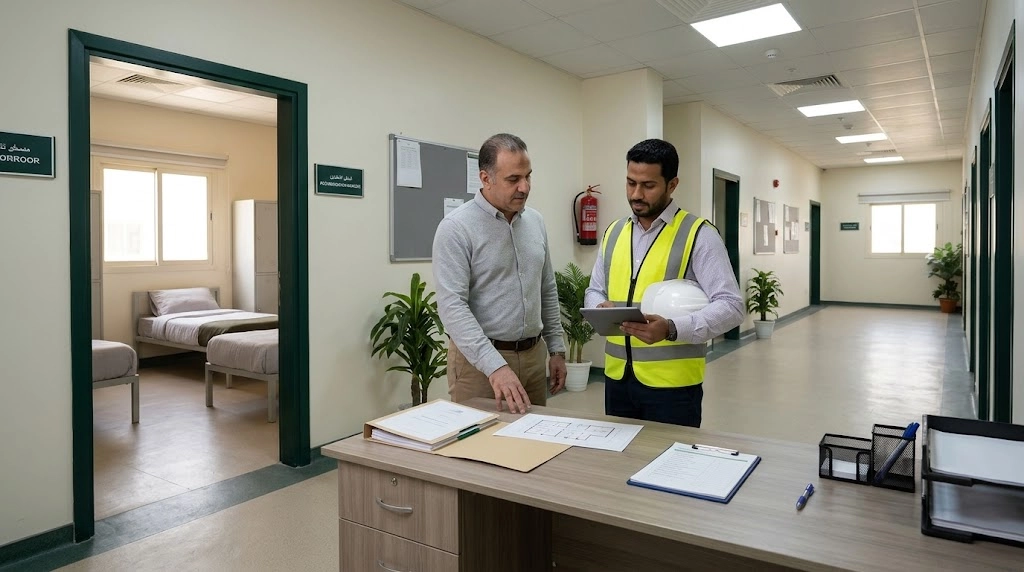
This guide explains the application steps and pre-inspection review, the difference between preliminary approval and the licence, the engineering office’s role, and how to track findings, fees and renewal. It focuses on managing the licensing file; furnishing and day-to-day accommodation operations should be defined under a separate scope based on the establishment’s needs.
If the site needs a readiness review or coordinated fit-out and operations, explore Terra Pulse’s workers accommodation and group housing services. Identify the party responsible for each inspection or regulatory deliverable according to its remit.
Quick Answer: What Is a Collective Housing Licence?
A collective housing licence relates to authorising accommodation after completing the relevant authority’s procedures and verifying the requirements applicable to the location and facility. Managing the application involves reviewing information, documents, inspections and further requirements until the final licence is issued.
When a company seeks worker accommodation licensing, it should confirm the service name, process and scope rather than rely on a general term. The licence, preliminary approval and certificate evidencing the tenancy relationship serve different purposes and should be distinguished.
How Do You Identify the Correct Licensing Process?
Establish the Property Location and Responsible Authority
Start with the accommodation’s coordinates, address, property type, intended use and supervising authority. Review the current Balady service, municipal requirements and any provisions for an area overseen by another authority.
Prepare a short property profile identifying the site, relevant party and current stage. Is the property unlicensed? Does it have an existing licence? Is renewal needed, or does a change in information or scope require review? These questions help avoid selecting a service that does not address the actual situation.
If the documented property description differs from its intended use, clarify the appropriate procedure with the responsible authority before arranging work or entering commitments on the assumption that the application will be accepted.
Who Can Submit a Licence Application?
The official issuance service lists individuals, establishments, government bodies and charitable entities among its beneficiaries. Inclusion of a category does not remove the need to verify the applicant’s correct capacity, relationship to the property and application requirements.
Define who creates and tracks the application, supplies documents, approves information and responds to findings. If an employee or representative handles the process, use the approved permissions and procedures rather than an account that does not correctly represent the relevant party.
Separate administrative and technical roles: the application coordinator tracks progress, the owner or tenant supplies property-relationship information, specialists inspect within their competence, and the responsible authority makes the regulatory decision.
What Is the Difference Between the Licence and Proof of Accommodation?
The accommodation licence concerns authorisation of the facility and its scope. A collective housing proof-of-accommodation certificate concerns evidence of a tenant establishment’s rental relationship within accommodation linked to that licence. Neither should be treated as a substitute for the other.
| Document or Stage | Purpose | What Should You Verify? |
|---|---|---|
| Collective housing licence | Licensing the accommodation through the relevant process and requirements. | Issuance, property details, scope and validity. |
| Proof-of-accommodation certificate | Evidencing the tenancy relationship associated with units in licensed accommodation. | Connection to the licence, establishment, units and tenancy relationship. |
| Lease | Defining the contractual relationship between the parties. | Parties, property, units, duration, use and obligations. |
| Preliminary approval | An intermediate stage before licensing procedures are completed. | Scope, subsequent requirements and completion deadline. |
The official collective housing proof-of-accommodation certificate service links the process to the licence number, tenancy and unit information, and licence-holder approval. Confirm whether the establishment needs this service without confusing it with the licence application itself.
How Do You Check Location Suitability Before Applying?
Use the collective housing requirements and prohibited-area enquiry service. Match the selected location to the property’s coordinates and documents, and retain the review result, date and relevant clarifications.
If restrictions appear or the applicable area is unclear, consult the municipality or responsible authority before proceeding. Similar accommodation in the neighbourhood does not establish that the proposed location is permitted.
Early verification helps establish whether the next step is to complete information, assess another location or arrange a specific inspection. It does not establish that all technical checks have been passed; location review is only part of the process.
What Information Is Required for the Application?
Prepare information from its original sources, then review the fields and attachments required by the current service. The issuance service identifies information including:
- The applicant’s capacity and details, with relevant commercial-establishment information where applicable.
- Accommodation coordinates, property type and building floor area.
- Room numbers, room areas and sanitary-facility information.
- Ownership or lease details according to the relationship to the property.
- Accommodation photographs and safety information required by the process.
For an organised review, record each data item, its source and verification date. Use consistent building and room identifiers across photographs, drawings and schedules so that every item can be connected to its actual location.
Do not present an estimate as a verified measurement. If an area, partition or facility cannot be confirmed, record the gap and assign responsibility for resolving it before the information is approved.
How Do You Review Ownership or Tenancy Information?
Match property identity and relevant-party details in the documents to the information entered in the application. Confirm that the relationship covers the intended building or units and that its dates and scope are clear, particularly where several establishments share a site.
- Are the property’s address, coordinates and details consistent across documents?
- Is the area to be licensed clearly identified?
- Are the parties and their capacities correctly recorded?
- Is the lease or supporting document complete and legible?
- Do any changes require clarification or another procedure?
Refer contractual questions or uncertainty over authority to apply to the relevant parties and specialists where needed. A material inconsistency should not be resolved merely by changing an application field without checking the underlying facts.
How Do You Prepare Occupancy-Capacity Information?
Create a schedule of rooms, floor areas, uses and supporting facilities, distinguishing available areas from those closed or out of service. Review proposed resident numbers against applicable requirements and specialist assessment.
An estimated figure entered into an application does not automatically become approved capacity. Bed count alone is insufficient: facilities, layouts, services and safety can affect the assessment.
Where a building is shared, clarify how rooms, facilities and capacity are allocated between parties. This helps prevent the same facility being recorded as fully available to several groups, or aggregate information being presented without identifying the premises covered by the application.
How Do You Review Safety Requirements Associated with the Application?
Check which safety documents the service requires and how they relate to the location, installed equipment and current information. Possessing a copy does not establish that it covers every area or that systems work at inspection time.
Ask specialists to review relevant findings and changes, such as altered partitions, additional equipment or a different use. Identify testing, maintenance or documentation updates needed before the visit.
Where technical work is necessary, coordinate the relevant fire protection systems scope with qualified providers, distinguishing installation and corrective work from inspection and required approvals. An internal checklist does not replace regulatory approvals.
How Do You Start a Collective Housing Licence Application on Balady?
The official description outlines a process beginning with selecting applicant capacity and the service, submitting information for location review, and completing subsequent requirements. The platform interface can change, so check the current service name and user guide when applying.
- Sign in: Access Balady using the approved authentication method.
- Select applicant capacity: Choose the capacity that correctly represents the situation.
- Choose the service: Open the collective housing licence issuance service and start a new application.
- Provide information: Complete the fields and attach what the service requests.
- Review and submit: Check consistency before confirming and retain the reference number.
- Track progress: Review the location-verification outcome and requirements for completing the process.
For a Balady collective housing licence, use the official licence-issuance service page to access the description, requirements and user guide rather than follow old screenshots that may not match the current interface.
What Happens During Location Review?
The issuance service describes municipal review of the location against spatial requirements, followed by an outcome or findings. This stage addresses matters specified by the process; it does not mean that all remaining inspections are complete.
If the application is returned, establish whether the finding concerns coordinates, information, use or a document requiring correction. Do not resubmit the same file without addressing the cause.
If the request is unclear, seek clarification through the official channel, quoting the reference number. Retain the response in the application file and assign each action to its owner rather than creating a general list the team cannot close.
How Does Preliminary Approval Differ from Final Licence Issuance?
Preliminary approval is not the final licence. Further requirements follow under the applicable process. The ministry’s service page states that the application can be completed within 90 days of preliminary approval. This is a completion period described by the service, not an issuance timeframe or automatic permission to operate.
Check the deadline and status recorded against your application, together with inspection, attachment and financial requirements. Do not base resident move-in on an earlier-stage notice instead of verifying the final licence, its scope and other relevant requirements.
Maintain a tracking record showing each stage transition, the next action, its owner and deadline so that the completion period is not lost between the owner, engineering office and applicant.
When Does an Engineering Office Become Involved?
The office’s role depends on the applicable process and responsible authority. The issuance service describes completion through the municipality or an engineering office, depending on the route, while the renewal service describes selecting an office and arranging an inspection.
Before appointment, verify qualification for the intended service and define the scope, outputs, visit and reinspection arrangements, and fees. Do not assume that every office provides every service or that a lump sum includes additional visits without clarification.
Also distinguish the party correcting defects from the party inspecting and documenting compliance under the relevant requirements. If corrective work involves electrical systems, HVAC and plumbing, coordinate the appropriate MEP and electromechanical works scope, followed by the required verification.
How Do You Prepare for the Inspection Visit?
Turn inspection preparation into a readiness checklist linking documents to the site. Make the relevant information and areas available for an organised visit while following safety procedures and respecting residents’ privacy if the accommodation is occupied.
- Assign a site representative and contact for access coordination.
- Prepare current application information, documents and available drawings.
- Use consistent numbering for rooms, buildings and facilities.
- Identify closed, defective or excluded areas.
- Provide inspection, maintenance and previous-finding closure records where required.
- Arrange specialist attendance where testing or technical access is needed.
- Review ongoing work that may affect visit safety or the accuracy of the inspected condition.
Do not ask administrative staff to open electrical panels or enter tanks or hazardous spaces to demonstrate readiness. Specialists should coordinate any special access or testing using appropriate procedures.
How Should You Manage Further Requirements and Inspection Findings?
Record each finding in its original wording with its reference, then identify the affected area and required action. Distinguish data corrections, document submissions, technical repairs and retesting, because each requires different closure evidence.
| Finding Type | Suggested Action | Appropriate Closure Evidence |
|---|---|---|
| Inconsistent information | Check the source and correct affected fields and attachments. | Information consistent with the correct supporting document. |
| Unclear or incomplete document | Provide a complete, valid copy as required. | A legible attachment clearly relevant to the application. |
| Facility or system defect | Define and complete the repair, then verify the technical outcome. | Repair records and appropriate testing or inspection evidence. |
| Layout or capacity discrepancy | Review actual conditions, information and the appropriate procedure. | Specialist outputs and updated, consistent information. |
| Unclear requirement | Request official clarification before assuming a solution. | Recorded clarification and a response addressing the requirement. |
Add the action owner, deadline and implementation status, then review the file as a whole. Changing the room count, for example, may require updates to several fields and attachments rather than one schedule alone.
Hypothetical Example of Correcting Inconsistent Information
If photographs show numbering that does not match the room schedule, randomly renaming one image is not an adequate solution. Check numbering on site, identify the correct rooms and update schedules, photographs and affected information before resubmission. This is an illustrative example, not a licensing application completed by Terra Pulse.
What Affects the Time Needed to Issue the Licence?
Actual duration depends on a clear process, complete information, location review, accommodation readiness, inspection coordination and responses to findings. A timeframe published on a service card is not necessarily the period from starting repairs to an unready property through to receiving its licence.
- Delays collecting documents or correcting applicant information.
- Clarification of the responsible authority or location suitability.
- Technical work needed before inspection or reinspection.
- Access arrangements and coordination between parties.
- Time taken to address findings, update attachments and complete required procedures.
Create a realistic programme separating data collection, works, inspection and regulatory review. Track submission, response and closure dates to identify the reason for delay rather than assuming every elapsed day is authority processing time.
How Do You Review Official Fees and Inspection Costs?
Separate official charges checked through the service and its calculator from engineering-office or specialist fees and the cost of correcting building defects. Combining everything into a single figure described as a “licence fee” can obscure what is included.
| Cost Item | How Should It Be Reviewed? |
|---|---|
| Official charges | Check the current service, fee calculator or financial procedure associated with the application. |
| Inspection fees | Obtain a proposal defining the visit, report, scope and reinspection arrangements. |
| Specialist measurements and tests | Define why they are required, the scope, provider and outputs. |
| Repair or fit-out work | Itemise works, quantities, specifications and acceptance separately. |
| Ongoing operations | Use a service contract defining cleaning, maintenance and other post-readiness services. |
The official renewal service links to Balady’s fee calculator. Review the calculation and application at the time of the procedure rather than treating another facility’s cost or a commercial quotation as a fixed official charge.
How Do You Track Licence Validity and Renewal?
Start managing collective housing licence renewal from the actual licence details and expiry date, then check current service availability and requirements. Do not wait until the last moment to discover maintenance work or missing documents.
The official collective housing licence renewal service describes selecting the licence, reviewing property, capacity and ownership or tenancy information, and completing the engineering-office and inspection stages. Organise renewal practically as follows:
- Verify the correct licence, its information and dates.
- Review changes to the site, rooms, facilities and parties since issuance.
- Prepare required information and attachments and identify gaps.
- Coordinate inspection, corrective actions and relevant financial procedures.
- Track the application until the renewed licence is issued, then verify its details.
If the accommodation scope or information has changed, confirm whether amendment or another procedure is required. Renewal does not automatically approve every alteration. Submitting a renewal application alone does not establish completion or change licence dates without issuance.
Common Mistakes That Delay Accommodation Licensing
- Selecting a service or applicant capacity that does not match the situation.
- Inconsistent coordinates or property descriptions across the application and attachments.
- Room or facility information that does not reflect actual conditions.
- Treating estimated occupancy as final capacity without verification.
- Confusing preliminary approval with the licence or proof-of-accommodation certificate.
- Scheduling a visit before access and required documents are ready.
- Resubmitting without evidence that the finding has been addressed.
- Overlooking the effect of one change on other records.
- Failing to clarify inspection and revisit coverage in the quotation.
- Not tracking deadlines, licence expiry or subsequent changes.
Use an internal review before each submission: has the requirement been addressed, have affected versions been updated, and can the reviewer follow the evidence? This helps organise the file without replacing the specialist’s or authority’s role.
Checklist Before Inspection and Resubmission
- Identify the application number, authority, process and current status.
- Review applicant capacity, relationship to the property and relevant documents.
- Match the location, coordinates and addresses.
- Update the schedule of rooms, areas, facilities and estimated information.
- Identify photographs and attachments and link them to site locations.
- Review required safety and inspection documents and their coverage.
- Arrange access and identify the necessary representatives and specialists.
- Record findings, corrective actions and closure evidence.
- Review deadlines, financial procedures and the next action.
- Retain the submitted version and submission evidence for later review.
After issuance, retain the licence alongside records of validity, changes and outstanding work. Maintenance, requests, assets and follow-up can be organised through facility management and digital monitoring services under the agreed operating scope.
How Can Terra Pulse Support Site Preparation and Operational Follow-Up?
Terra Pulse can define a scope for reviewing room, facility and asset readiness, identifying fit-out and maintenance work, and organising records, responsibilities and operations according to accommodation needs and the agreement. These activities support the correction of relevant operational and technical gaps.
Responsibility for a legally valid application, regulatory inspection, reports and approvals must be allocated to the appropriately qualified parties under the applicable requirements and process. Fit-out or operating services do not guarantee licence issuance or approval on behalf of the authority.
Need to identify work required before your accommodation inspection? Share the location, property type, room count, current stage and available findings with Terra Pulse on WhatsApp to discuss an appropriate assessment and preparation scope.
Frequently Asked Questions About Collective Housing Licences
What is a collective housing licence?
It is the licence associated with collective accommodation after the relevant authority’s process and applicable requirements have been completed. Check its details, scope and validity. A lease or preliminary location approval does not replace it.
Who can apply for the licence?
The official service lists individuals, establishments, government bodies and charitable entities. Applicants must select the correct capacity and verify their relationship to the property and authority to apply under the relevant process and service requirements.
How do I identify the authority responsible for my location?
Establish the property’s coordinates, type and supervising authority, then review Balady’s service and the relevant municipal requirements. If a separate authority oversees the area, clarify its remit and coordination procedures before starting the application.
What information is required for an accommodation licence?
Prepare applicant and property details, coordinates, floor areas, rooms, facilities and ownership or tenancy information, together with photographs, safety documents and attachments required by the applicable process. Match the information to the site and supporting records before submission.
Does preliminary approval mean the licence has been issued?
No. It is an intermediate stage followed by further requirements and inspections under the applicable process. Do not treat the accommodation as licensed solely because preliminary approval has been granted; verify the final licence, its details and validity.
When does an engineering office need to inspect the property?
Its role depends on the applicable process and responsible authority. The issuance service describes completion through the municipality or an engineering office, depending on the route, while the renewal service describes the office’s inspection role. Verify the provider’s qualification and required inspection scope.
What can delay licence issuance?
Potential causes include inconsistent applicant or property information, incomplete attachments, location or technical findings, restricted site access, delayed corrective work or resubmission, and outstanding financial procedures.
How should accommodation licence renewal be managed?
Record the expiry date and review renewal availability and current requirements well in advance. Update information, complete inspections, corrective actions and required procedures, then verify that the renewed licence has been issued and check its dates. Submission alone is not renewal.
After issuance, continue monitoring validity, renewal, changes and operational readiness. You can contact Terra Pulse to discuss accommodation preparation and management, while distinguishing that scope from the role of regulatory authorities and approved specialists.
Official Sources and Procedure Updates
Check steps, attachments, deadlines and charges in the current service and application, because the interface, process and requirements can vary by situation and authority. This guide supports understanding and coordination; it does not replace instructions or decisions issued for a specific application. The official resources linked below are in Arabic.
- Ministry of Municipalities and Housing: Collective housing licence issuance.
- Balady: Collective housing licence issuance service.
- Collective housing requirements and prohibited-area enquiry service.
- Collective housing proof-of-accommodation certificate service.
- Collective housing licence renewal service.
- Balady: User guide linked to the collective housing licence issuance service.
